Wednesday, 1 July 2026

Newsletter July 2026: Reznikoff


Quiet days. Not much coming in or going out (the lady at the post office today says she’s missed me, and I’m looking thin). But we had a terrific party for Mike Bradwell’s Axholme at the Bush Theatre in mid-June, and there’s Penelope Curtis’s The Fall to look forward to in September. So this newsletter occupies a holding place.

Humming along in the background is Reznikoff. His major work, Testimony – originally published in sequential books in the 1960s and 70s, following an early version in 1934 – is a masterpiece of 20th-century modernist literature. Fact. It also happens to be a political book. Charles Simic: ‘It should not be surprising that Testimony is rarely assigned at our colleges and universities these days; it causes too much discomfort to those who prefer to know nothing about what goes on in the world.’ Jena Osman: ‘To shine a light from a different angle, to make you think about what’s there in a different way – that’s the best political work that poetry can do.’ August Kleinzahler: ‘J'accuse . . . Crystalline, documental vignettes – dispatches, really, from the front of American capitalism's assault on the poor, dispossessed and vulnerable.’ Never previously published in the UK, Testimony will be published by CBe early next year – by far its biggest book to date: large format, 608 pages.

Reznikoff – born in Brooklyn in 1894 to immigrant parents, died in 1976 – was one of the Objectivist poets who first published in the 1930s; in the 1960s and 70s they were inspirational figures for a number of British poets working outside the mainstream. While his work has been translated into Polish, German, French, Spanish, Portuguese, Italian and Swedish, not a single book by Reznikoff is currently available in the UK.

Around publication time there’ll be a live reading of the whole text of Testimony over three days in a gallery in central London, with anyone who comes through the door welcome to take part. Alongside Testimony, Redstone Press will publish The Sound of the Street, selected poems by Reznikoff presented alongside photographs of early 20th-century New York by Berenice Abbott and others. Much of Reznikoff’s work was not just self-published but printed by himself; both CBe and Redstone are one-person outfits; the publication of these two books is a statement, of sorts.

A 40-minute film titled Living and Seeing: Charles Reznikoff, made in 2024, can be seen here. (There’s a moving sequence near the end when, while R is reading, there’s a power cut – ‘Just when you least expect it, the lights go out. And when you least expect it too, the lights go on.’)

Above: homework. Below: a card published by Anthony Rudolph’s Menard Press in 1976, the year of Reznikoff’s death; image by Jan Le Witt, poem (inset) by R.

Thursday, 16 April 2026

Ágota Kristóf


There’s a long piece (6,759 words) by Sarah Resnick in the new issue of the LRB on Ágota Kristóf, following the publication by Penguin last year of Kristóf’s slim book (96 pages) of short stories, I Don’t Care. Most of the piece is about Kristóf herself, and about the Notebook Trilogy – The Notebook (1986), followed by The Proof (1988) and The Third Lie (1991), which ‘secured her reputation as a major postwar author’. The Trilogy has been in print with CB editions for a more than a decade but the LRB has never reviewed a CBe book. Annoyingly, the LRB piece appears at a time when the Trilogy is not available – publication rights have moved from CBe to Penguin, who will publish in November, and meanwhile I’ve been told to stop selling the CBe edition and remove it from the website. But copies of the CBe edition of the Trilogy do exist – right here, in a box by my desk – and if you want a copy now, rather than wait until Penguin publish later in the year, please contact me.

Kristóf’s The Illiterate, also discussed in the LRB piece, is still available from CBe, which published the first English translation in 2014 and re-issued it in 2022. But not for long: Penguin now have the rights to that too, and I’ll soon have to stop selling the CBe edition.

In his introduction to the CBe edition of The Illiterate, Gabriel Josipovici notes that when Kristóf was aged fourteen and still living in Hungary (she fled to Switzerland in 1956), her father was imprisoned, ‘we must presume for falling foul of the Communist authorities’. Sarah Resnick writes well about all of Kristóf’s work and her piece is informed by recent research which found that Kristóf’s father was imprisoned not for political reasons but for the sexual abuse of children at the girls’ school where he taught. More on that here.

Wednesday, 8 April 2026

Newsletter April 2026: new book, and news of another


Here is Axholme by Mike Bradwell, to be published in June on what will be his posthumous birthday (he died in April last year). Bradwell founded Hull Truck theatre and for over a decade was director of the Bush Theatre, a few streets away from this desk, where there will be a party: balloons, cake, wine and hugs. Axholme portrays a childhood in a village in Lincolnshire in the 1950s in the voice of a nine-year-old kid. It’s rude and funny and not in the slightest bit sentimental. Laurie Lee, move over. Mike Leigh: ‘A wonderful, moving evocation of a vibrant community – funny, poignant, and above all, real.’

Fourteen Ways of Looking by Erin Vincent was published by CBe in March, and is now also published in Australia, the US and Canada. Sarah Manguso: ‘Magnificent, simply one of the best books I’ve read in ages. I read it in a reverie of blissed-out, horrified amazement.’

It’s good that CBe doesn’t have shareholders, because the figures for the financial year just ended wouldn’t make them happy. The only people CBe is accountable to are readers. Thank you very much to those who pressed the ‘Donate’ link on the website home page: still there, and anyone who presses it gets a copy of a limited-edition 32-page full-colour booklet called Vedute a colori.

Early next year – which, if we get there, will be CBe’s 20th birthday – CBe will publish its largest and longest book to date. Testimony by the poet Charles Reznikoff (1894–1976) happens to be – and I’m not entirely alone in thinking this – one of the major English-language works of the past century, and has never been published in the UK. It was originally published piecemeal between 1934 and 1978; in 2015 in the US Black Sparrow, now an imprint of David Godine, gathered the whole thing (including the original prose version, out of print for decades) into a single edition, and this is the edition – large format, 608 pages! – that CBe will publish in the UK.

The poems in Testimony are derived from court records from across the US between 1885 and 1915. Other poetry titles from CBe based on documentary records of the lives of others (interviews, photographs, emails …) are Sarah Hesketh’s 2016, Caroline Clark’s Sovetica, J. O. Morgan’s Natural Mechanical and Long Cuts, and Dan O’Brien’s War Reporter and New Life, and Testimony may be the mother and father of them all.

Reznikoff is little known in the UK (the US too). But some people know him, and I’d be very happy if any of those who do get in touch. Publishing this book is a statement: about small presses (much of Reznikoff’s work was self-published and printed by himself), but it's also about why write, why publish. Any history of Modernism in literature that doesn't include this book needs kicking.

Tuesday, 17 February 2026

CBe newsletter February 2026


Fifty-odd years ago Herbert Lomas, a lovely man and very good poet, published a book suggesting that we could solve a lot of problems by just getting rid of money. Title: Who Needs Money? Lomas doesn’t, now – he died in 2011 – but in the meantime CBe does. Earlier this month Waterstones returned books that they’d ordered in and failed to sell and got a refund of £970. That’s a big pothole in the road that needs to be filled in. There is now a Donate link on the website which will set you back £20. You can press it once, twice, many times, or not at all. Anyone who does press it will be sent, as a thank-you, a copy of an odd little CBe booklet titled Vedute a colori: 32 pages, printed in colour, 150 copies only and just some of those reserved for the pushers of the Donate button. The booklet reproduces postcards from three series and adds minimal text.

There’s a fine review of Patrick McGuinness’s Ghost Stations in the current Literary Review by Jonathan Keates: ‘I love Ghost Stations. I wish I’d written it myself. Its tones are civilised, funny and humane …’

The CBe edition of Agota Kristof’s Trilogy is now officially out of print. It will be republished later this year by Penguin, who will also take over Kristof’s The Illiterate. But the last copies of the CBe edition of Trilogy are right here, in a box by this desk, and available from the website.

The two 2026 CBe titles available from the website are Farah Ali, Telegraphy (January) and Erin Vincent, Fourteen Ways of Looking (March).

Friday, 23 January 2026

See no evil

J. B. Smith was my English teacher when I was aged 16 and I owe him much. He left the school in 1967 after just three years and below is a clipping from the school magazine that records his departure: ‘His views were often startling, sometimes unorthodox … he believed that English could be enjoyed at the same time as it was taught in a scholarly way, he felt strongly on national and international problems’. He introduced me to new writers and asked good questions. Before the long summer holiday he suggested I read Anna Karenina and then, back at school, asked not just if I’d liked it but why. I wrote for him – who else was there? – long essays on Lawrence and Blake and another on King Lear in which I argued that Lear was a fool for not recognising the goodness of Cordelia and he deserved all he got.


The other teacher whose departure in 1967 is recorded in this clipping is G. A. Ray-Hills. He gets an even warmer send-off – ‘His keenness, gaiety and conscientiousness were boundless … He will long be remembered at Loretto with affection and gratitude, as a French teacher of undoubted genius and as a man of wide and varied interests and of sparkling personality who contributed so much of value to the school’ – but I was lucky to escape him.

G. A. Ray-Hills features (with certain other teachers) in the 200-page report on this school published by the Scottish Child Abuse Inquiry in 2023 and available online (‘Case Study no. 9: Volume 1. The provision of residential care in boarding schools for children at Loretto School, Musselburgh, between 1945 and 2021’). This is from the summary:

• Guy Ray‑Hills, a charismatic and flamboyant teacher at Loretto junior school, the Nippers, between 1951 and 1967, was a prolific sexual predator of junior and senior boys throughout his tenure. He groomed many children and established abusive sexual relationships with them. Some were isolated incidents, but others lasted for years.
• Children whose parents lived abroad, often thousands of miles away, were particularly vulnerable to Guy Ray‑Hills.
• Ray‑Hills’s behaviour was widely known about by pupils. It was blatant and headmasters and other staff must also, or ought to have, known about it. He was the subject of a number of complaints from the 1950s onwards.
• Guy Ray‑Hills lost control and beat children sadistically, particularly those he did not groom for sexual abuse. He knocked a child out by punching him.


The children at the junior school where Ray Hills taught were aged between 8 and 13. The abuse ‘included masturbation, oral and anal sex. It was regular, and it was illegal.’ It was also known to what the report calls ‘the senior leadership team’, who did nothing – maybe, the report speculates, because of ‘concerns about the risk to the school’s reputation, or a failure to appreciate the enormity of what was happening, or a failure of governance …’ Also: ‘There is no indication of any thought being given to the impact on children of Ray‑Hills’s abuse and, rather than take steps to protect other children from his paedophilic appetites, the actions of the school paved the way for him to access children again.’

Ray-Hills left the school with references that described him as ‘exceptional, enterprising, hardworking’ and ‘ignored the history of complaints about him abusing children’. Ray-Hills continued to teach, and abuse, in other schools until he retired in 1991. He died in 2010.

Jimmy Savile. Epstein. Trump. And everyone who turned a blind eye.

Monday, 5 January 2026

CBe newsletter January 2026


Here we go again. First, a reminder that Telegraphy by Farah Ali is published this month and there’ll be party for the book at Burley Fisher Books, 400 Kingsland Road, London E8 on 15 January – full details here. It’s a free event and there’ll be money behind the bar but the bookshop would like you to tick the Add-to-Cart box if you’re minded. Please do. Please come.


Next: Erin Vincent, Fourteeen Ways of Looking, published in March, finished copies due any day. Next, Mike Bradwell, Axholme, June. Anonymous puff quote for Axholme, which may or may not actually appear on the cover: ‘Pisses all over Cider with Rosie.’ Rude and funny and a lot more, this is village life in England in the 1950s – for me, hitting 75 later this month, almost yesterday. Next, Penelope Curtis, The Fall, September: interwoven stories (told mostly from the perspective of the sidelined women) of people who cross paths over time in a single small village in Lincolnshire – Isaac Newton measuring the motion of heavenly bodies; the Rev. Charles Hudson, intent on climbing the Matterhorn; the actor David Niven, intent on women.

Mickey Mouse manages to be both an emblem of the Walt Disney Company, a beacon of global capitalism, and a derogatory term used by Tory MPs to decry the kind of college courses taken by people seeking vocational qualifications. CBe is a kind of Mickey Mouse operation – it’s held together with string and sellotape – but is now into its 19th year.

Monday, 8 December 2025

Teeth: On negative reviews


One of the funniest episodes of last month was a friend telling me that, coming on the Tube, he’d read one of the Poems on the Underground and hadn’t been impressed. More than unimpressed: he had actively taken agin it, he had wanted to stand in the middle of the carriage and say in a very loud voice: ‘Read that – does anyone think it’s good?? That’s the kind of poem that can put people off poetry for life.’ He sat down next to me and googled the poem on his phone and insisted on reading it aloud, exasperated by every line, and this was funny because I know his exasperation. My encounter with two recent, widely praised novels followed a similar trajectory: I began reading slowly, respectfully; I became impatient; I did some skim-reading; I placed them on my pile of books-to-take-to-the-Oxfam-shop.

The chorus of approval surrounding many new books begins pre-publication with puff quotes for the cover from other writers, with ‘books to look out for’ features in the Guardian, and with excited freelance reviewers posting pictures of their advance copies; post-publication, if there are good reviews and author interviews and ‘profiles’, the chorus can feel wraparound. Stifling. Airless. In this context, negative reviews have a thrilling whiff of iconoclasm, of smashing a statue in a church. Not negative reviews of books (and films, TV shows, restaurants) that are widely agreed to be pretty terrible, because their target is low-hanging fruit and the reviewers are saying little more than see how witty I am, but well-argued negative reviews of books that have been praised elsewhere and get ‘likes’ all over the place and have won prizes. These are different; they feel personal.

Recent examples: Michael Hofmann’s TLS review of Colm Toíbín’s The Magician (‘Crap hat, no rabbit’) and Tom Crewe’s LRB review of Ocean Vuong’s The Emperor of Gladness (‘not a fruitful, poetic ambivalence, but sheer clumsiness’). Tom Crewe’s review begins by quoting some of the quotes on the paperback of Vuong’s previous novel: ‘A marvel … brilliant and remarkable … a masterpiece … staggeringly beautiful …’ And then he quotes some of the sentences that, starting to read the book, he stumbles on, and I can almost taste his own exasperation. You have paid for the dish of the day and it’s luke-warm and stodgy.

I am not a contrarian, which would be tedious, and I’m not, I think, a Grumpy Old Man (there are more than enough of those, and they’re getting grumpier). I think the Poems on the Underground scheme is terrific; I like many of the books that lots of other people like; there are new books every year that surprise and delight me, and they’re not always the ones I might be expected to like. It is, always, personal.

Actually I think choruses of approval – most of which are orchestrated: this what publishers’ publicity and marketing departments are paid to do – are seeing diminishing returns. How many masterpieces can there be? Even the informal choruses – the ‘likes’ on social media – result, in my own woodshed-corner experience, in fewer actual sales than they used to. People have less money (except those who have more, but they tend not to buy books). ‘Disposable income’ is a joke. People 'like' and move on and don’t follow through. I’m guilty as charged. What will happen next: more hype, more marketing, more of the same, an escalation of the arms race, because that’s how the system is set up. It’s all kinda silly but I am serious about this, otherwise there’d be no point.

Monday, 1 December 2025

CBe newsletter December 2025


Christmas. Presents. Books are even easier to wrap than bottles. See the home page of the website and bear in mind the Season Tickets: 6 books for £50, 10 for £75. Within the UK, free postage. This is the best of these deals on offer, it really is.

Buying a book for X can be tricky. X might not just not like the book, they might decide that if you thought they would like this then even after all these years you haven’t really understood who they are, and your whole relationship is on the line. You could buy X a book that won one of the big prizes but that’s outsourcing your choice to random panel of judges and is just bland. The point of the Season Tickets is that you choose which books; and if you’re buying for X you’re spreading your bets – X is unlikely to dislike all of the books you’ve chosen. Or you could let X choose for themself: ask them to, or buy the Ticket and send me their email and I’ll take it from there.

There are around 80 titles on the website to choose from. Some are available exclusively from the website – books with only a few copies left may be officially out of print at the distributor, and so not in bookshops, but are still available from the website.

These are the first two books out of the block for next year:


Farah Ali’s Telegraphy, which will publish in January, is available from the website now. Erin Vincent’s Fourteen Ways of Looking, which will publish in March, is now printing and will be available in January. Both books, not through any effort of my own, already have US publishers (and Erin Vincent’s in Australia too). A little later, Axholme by Mike Bradwell (1948–2025), who founded the Hull Truck theatre company in the early 1970s and ran the Bush Theatre (my local) from 1996 to 2007: voiced by a nine-year-old boy in a village in Lincolnshire in the 1950s, it’s a wonder.

My last day in an office (which I’d gone into at 9.30 each weekday for fourteen years) was the last working day before Christmas 2005, twenty years ago. Quitting the day job has turned out to be one of my better decisions; I’ve made worse.

A first for me: attending a Leicester Square premiere screening. I went because I’m more than a little obsessed with the actor Billy Bob Thornton, and I’ve written about this on the CBe blog, Sonofabook: here.

Thursday, 20 November 2025

Billy Bob and I

Twenty-odd years ago Julie and Brian from next door told me they’d seen me in a film they’d watched the previous night so I watched it myself and they were right. Billy Bob Thornton In the Coen Brothers’ The Man Who Wasn’t There is me. Here I am on the cover of the published screenplay, holding a broom in a small-town barbershop on a quiet day in 1949:


I became a little obsessed. Billy Bob’s birthday is 4 August, which is the date the First World War began and a recurring date in Ford Madox Ford’s The Good Soldier and the publication date of my first novel. I so wanted to know that Billy Bob is left-handed, like me, that the third or fourth time I watched the film I kept a tally of how often he holds his cigarette in his left hand, how often in his right. The left hand wins. But when he kills a man, he’s holding the knife in his right hand.

The Man Who Wasn’t There is a very good film and it has the same basic plot as James M. Cain’s novel The Postman Always Rings Twice. (I’ve written about this in The Other Jack.) Ed Crane in the film and Frank Chambers in the novel are very different characters – Ed is a perpetual bystander (‘I didn’t see anyone. No one saw me. I was the barber’), while Frank has a raging sexual appetite – but both get away with one murder and are then convicted of another that they didn’t commit. While they are on death row, both characters write down their versions of what has happened – Ed for a men’s magazine called Gent that’s paying him 5 cents a word, Frank writing the book we are reading (though he’s relying on the prison chaplain to ‘look it over and show me the places where maybe it ought to be fixed up a little, for punctuation and all that’).

The narratives of both Cain’s novel and the Coen Brothers’ film echo the early 18th-century ‘True Confessions’ of prisoners awaiting execution that jump-started the English novel. As with Ed Crane and Frank Chambers, Jack Sheppard’s first-person account (‘as told’ to Daniel Defoe) of his robberies and his several escapes from prison gained authority from being spoken ‘on the brink of eternity’: aged twenty-two, Sheppard was hanged in November 1724; a third of the population of London followed his progress from Newgate in an open cart to the gallows at Tyburn. Writing was not going to save Sheppard, Crane or Chambers from the noose or the electric chair, so why did they do it? Sheppard is telling his tale, he insists, ‘to satisfy the curious, and do justice to the innocent’. I think Crane and Chambers might have said the same; they felt a need for some kind of justice which for better or worse they associated with the written word.

As well as with justice, writers are often obsessed other writers (see, for example, Nicholson Baker’s U and I and Matthew De Abaitua’s Self and I) and sometimes with singers, artists, actors . . . Some obsessions are long-lasting (I had a thing about Stendhal that went on so long I wrote a novel about him in an attempt to put it to bed); some are ‘mild’ or even ‘unhealthy’; others are simple fandom. Last Sunday there was a premiere screening in Leicester Square of the second series of Landman, which streams on Paramount and stars Billy Bob Thornton, and a friend of a friend had spare tickets and I grabbed one. I went with my copy of the screenplay of The Man Who Wasn’t There for Billy Bob to sign. Fond hope, and an odd thing to do: I do not collect autographs and generally have no interest at all in signed copies of books. Billy Bob was there, in a red cowboy hat, but a Leicester Square premiere isn’t exactly a poetry reading in a pub where you can wander up and say hi: he was there on the heavily patrolled red carpet, and then far away on the stage, and then at the after-party in the VIP room behind a curtain. I got some curious looks and a woman asked me if I was Billy Bob’s father and I drank three margaritas and came home.

Thursday, 9 October 2025

CBe newsletter October 2025


RIP Tony Harrison, 1937–2025. Except of course that I don’t want him to be resting in peace, I want him to be carrying on doing his awkward, troublesome, angry and sometimes tender but always honest thing. That he did this in so many forms – poetry, theatre, film – means there isn’t a convenient pigeonhole in which to bury him. He was both European and very local, from Leeds: the photo is of my first buy, 55 years ago.


This newsletter has nothing immediate to sell (except the whole backlist in print, 80-odd books, and please do click a button or two on the website) but Farah Ali’s Telegraphy, to be published in January, is now printing and will be up on the website for pre-orders very soon. Farah will be in conversation with Dur e Aziz Amna at Brick Lane Bookshop next Wednesday, 15 October: details here.


Substack, for me, is largely sub, off my radar, but an exception is the one written by Katy Evans-Bush, whose Joe Hill Makes His Way into the Castle was published last year and was a Guardian poetry-book-of-the-year pick. Don’t listen to the party conference speeches, don’t read reports of them, read Katy’s most recent post. American-born, she’s in Kent, frontier-land: ‘Dover […] is here, of course. Dover the town, the beach, is where the small dinghies land once they’ve made it from France. And of course Dover the cliff is an unofficial national symbol, bluebirds or no.’ Katy, like many of the non-UK-born people I know, has a far better understanding of UK history than most English people (I think the Scots and the Welsh and the Irish get it better), including me.

The harvest festival will take place at the Conway Hall in London on Friday and Saturday, 23 and 24 October. I mean the Small Publishers Fair, the annual event at which small publishers come out of their solitary caves and surprise themselves by being sociable. And books are sold, not just apples and pears but fruits even your local independent greengrocer doesn’t stock. Please come – full details here.

And then a couple of rare trips out of London: CBe will be the Bath Indie Book Fair on Saturday, 8 November; and at the Dublin Small Press Fair on 28/29 November.

Wednesday, 3 September 2025

CBe newsletter September 2025: In bad times


Two reasons why there has been little news of late. One, CBe isn’t publishing many books – except this month, September, Patrick McGuinness, Ghost Stations: Essays and Branchlines, see here. Subtle, sensible, surprising, immensely intelligent essays by a man who publishes in more forms and speaks more languages than I have fingers on one hand. Second reason, which is in fact the first reason: in the context of the very bad shit that is happening in the world right now, and the complicit refusal of the UK’s media and government to acknowledge the scale and horror of it, promoting a few good books can feel beside the point. I don’t think I’m alone here.

Anyway. The soil is toxic but I cultivate a little garden. Last week a very good review of Caroline Clark’s Sovetica appeared in Tears in the Fence; excerpts are on the book’s website page. I am very excited about two books that are almost ready to send to print and that CBe will publish early next year: Farah Ali, Telegraphy, and Erin Vincent, Fourteen Ways of Looking.

Again, a mention of the Season Tickets available from the website: 6 books of your choice for £50 or 10 for £75, free UK postage. This is much better than Amazon: some CBe books are listed on Amazon as ‘not currently available’, others are listed there with crazy prices (£41.78 for a book selling on the CBe website for £8.99). The disrespect here is large and mutual. For anyone buying one of those Season Tickets, a free copy (while limited stock lasts) of the A1 poster of CBe covers 2007–26. Oh, and why not, I’ll add in a free copy of Leila Berg, Flickerbook, or Todd McEwen, Who Sleeps with Katz – just email to say which.

Jonathan Main of Bookseller Crow in Crystal Place – a bookseller I have respected, for many years – has died. Sincere condolences to everyone in that shop. Things are not going well.

Wednesday, 23 July 2025

Pick'n'mix: newsletter July 2025


Pick’n’mix: choose – from any of the books in the photo or on the website – six for £50, ten for £75: see the Season Tickets on the home page of the website. From titles first published in 2008 to this year’s new ones; free postage, UK only. These deals were first offered during the Covid lockdowns, when they were a lifeline. Currently, the weather is good but sales are slow and I need to be going to the post office more regularly. Until I run out of them, posters (A1 size, eats up wall space) showing the book covers 2007–2026 will be sent free with every Season Ticket.


Below, Sheila Ramage in the bookshop/shed in Notting Hill that she ran for 45 years. ‘The loveliest person in the trade’ – Marius Kociejowski. She was generous and fun and immensely knowledgeable, and this place was about as good as human civilisation gets. It was formative. Sheila died in 2020. I’ll be talking about her briefly at 2 p.m. this Saturday, 26 July, in this very place, now the Bouda Gallery (132 Palace Gardens Terrace, W8 4RT), at an event organised by Steven Fowler. Free entry. Come.

Back in 2014 CBe published Ágota Kristóf’s brief memoir The Illiterate (translated by Nina Bogin) and brought back into print The Notebook (translated by Alan Sheridan). Still in print with CBe: The Illiterate and Trilogy (The Notebook, The Proof, The Third Lie). In August a collection of stories by Kristóf titled I Don’t Care (translated by Chris Andrews) will be published by Penguin, and in the next year (roughly) the Trilogy will also move to Penguin. For readers and for Kristóf (she died in 2011) this is good: she should have been on the Penguin modern classics list years ago. On 21 August the London Review Bookshop will host an event to celebrate the publication of the stories – tickets available here.

Thank you all for keeping this thing going.

Saturday, 31 May 2025

"Run up the colours": newsletter May 2025


Early books, above … 176 Interruptions, scheduled for July, is a revised and expanded edition of 99 Interruptions (published in 2022 and now almost out of stock). In Ghost Stations: Essays and Branchlines, scheduled for September, Patrick McGuinness – novelist, poet, translator, editor, critic and speaker of several languages – writes about his personal history, the unofficial histories of places in which he has lived, and some of the lesser-known byways of European literature and art. Both books are available for pre-order now from the website.

The encounter with the bear that resulted in three fractured bones in my neck (see previous newsletter) is now history: the bones have healed, the neck brace I wore night and day for two months has been discarded, the bear has gone over the hill. Early in Master and Commander, one of several old films I watched over the past weeks while slumped on the sofa, Captain Aubrey gives this order: ‘Mr Boyle, run up the colours.’ So I did. Below, a slice of unfinished history: a size-A1 poster of the CBe book covers (and 3 pamphlets, 2 issues of a magazine) 2007 to now. The history is ravelled: some of the books are now out of print, some have gone to other publishers, some have been reprinted with different covers. There’s only one print of the poster; I may print a limited run, but how many people have enough spare wall space for a poster?


Shelf space may be easier. Eighty of the books on the poster are available from the website, either individually or – for bargain-hunters – in one of the Season Ticket bundles, 10 books of your own choice for £75 or 6 for £50. Among them are the last two books of Paul Bailey, who may now be among ‘the riotous dead’ but whose life was celebrated at a memorial service last week in the spirit of the titles of his books: Inheritance and Joie de vivre.

Saturday, 3 May 2025

The Silly Season


The non-story so far … A man announces he’s setting up a press that will ‘focus on literary fiction by men’. He says he plans to publish three books next year. To date, he has taken on nothing. His website (which looks as if it’s been thrown together in 5 minutes) announces a submissions window of just one month (the current one) and offers no explanation at all of why the focus on men. Or any info about, you know, the tedious details of actual publishing: distribution, design, funding, etc. This is a hoax, isn’t it?

The non-story starts becoming a story when The Bookseller picks it up, and then the Guardian and The Times (‘Men-only publisher hopes to fix “imbalance” in world of books’), and then a BBC4 radio programme, and then a list of ‘Ten Independent Publishers to Watch in 2025’ (even though there simply ain’t anything to watch: no books till next year), and then the Guardian again with an op-ed story. The man who is starting the press mutters something about male writers of literary fiction getting a bad deal: they are under-represented, or overlooked. One’s heart bleeds. And suddenly everyone starts quoting statistics at each other – numbers of women/men on prize shortlists and bestseller lists, numbers of men/women working in publishing – and journalists ask agents for soundbites.

It’s quite possible that there are more good women writers around than men. It’s also quite possible that that editors at big commercial publishers are under pressure from their owners to deliver the New Sally Somebody (smart, young, female, photogenic, ticks the boxes). That’s how business – ‘the publishing industry’, ha – works. It is not how small independent publishers work. Some of these publishers do offer ‘correctives’ to mainstream bias – by championing POC or working-class writers or work in translation – and over time they can make a difference; but what I’m looking at here (and I’m putting this as kindly as I can) is a solution in search of a problem. Move along now. The only story here is about the crass, knee-jerk, clickbait way in which anything about books is treated by the media, and even that story isn’t news.

Friday, 11 April 2025

The Other Other Jack

‘How old are you, exactly?’

‘Do you talk to other people in line for the bus or do you just eavesdrop for the cute overheard phrase?’


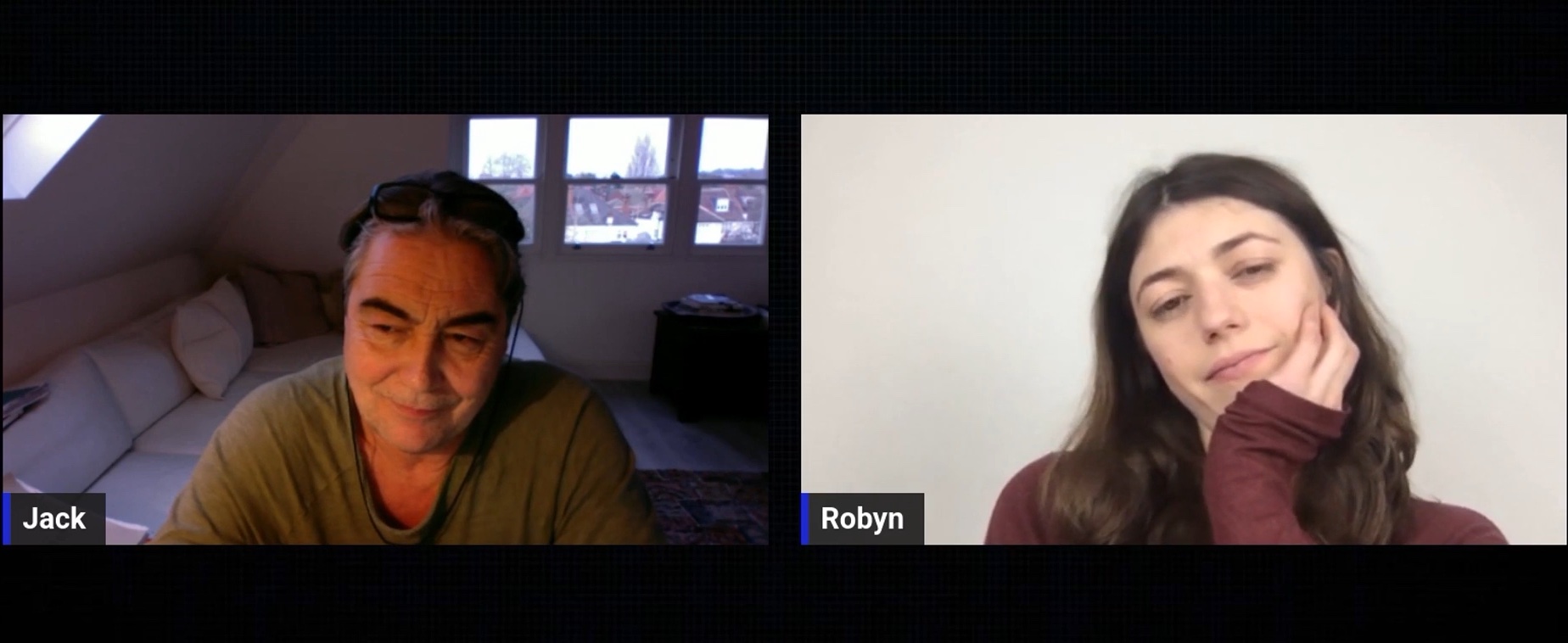
Above is a screenshot from a reading of the stage adaptation of The Other Jack, directed by James Dacre, with Jack (played by Nathaniel Parker) on the left and Robyn (played by Jasmine Blackborow) on the right. The script is by the US playwright and poet Dan O’Brien (CBe has published his poetry and essays). It’s based on the book of the same name by myself, published by CBe in 2021, with some material also coming from 99 Interruptions.

The reading can be streamed free on Vimeo until 22 April – you’ll need to register here with the Lortel Theatre, who will send you a link and a password. It’s an hour and a half long. We are busy people. If you’re pressed for time maybe fast-forward to the five minutes beginning at almost exactly one hour in (1:00).

The original book is loosely constructed around a series of conversations in cafés between a man (a writer, ageing) and a woman (a waitress, much younger). They talk ‘about books, mostly’, according to the cover, but also about ‘bonfires, clichés, dystopias, failure, happiness, jokes, justice, privilege, publishing, rejection, self-loathing, shoplifting and umbrellas’. The man is me, or is me as much as Jack Robinson is me, and here I am being evasive again, something that Robyn picks me up on. The play is not the book and I could say that the Jack in the play is not me but Dan O’Brien’s script is self-effacingly faithful to the book so it is me, whether I like it or not. On the left, smug ageing writer; on the right, young woman concocted to demonstrate writer's self-awareness of his smugness – so that's all right then. There’s something monstrous here.

Thursday, 3 April 2025

Newsletter April 2025


[Photo of early CBe books by Martina Geccelli]

Invisible Dogs was on the shortlist for the Republic of Consciousness Prize and that was a Good Thing. Congratulations to the winner, Bullaun Press, publisher of Gaëlle Bélem, There’s a Monster Behind the Door, translated from the French by Karen Fleetwood and Laëtitia Saint-Loubert. This prize is designed to reward small presses rather than individual authors or books, and by being on the shortlist CBe nets £1,500, which is more than helpful.

A not-so-good thing is that the distributor has raised charges (i.e, the percentage deducted from sales income on every book sold out of the distributor’s warehouse before it’s passed on to the publisher). And has instituted a new charge on books that sell zero copies over a 3-month period. This charge will affect a large number of CBe titles – currently including books by, among others, Caroline Clark, J. O. Morgan, Beverley Bie Brahic, Roy Watkins, Jack Robinson (me), Dai Vaughan, Nuzhat Bukhari, David Wheatley, Julian Stannard, Dan O’Brien – and potentially, given that in the current 3-month period many other titles are selling only one or two copies, and in the next period may not even do that, many more. Selling small and slow and sometimes zero for 3 months is what many CBe titles do, and I’m fine with that, but I’m being charged here for the privilege of not making money.

Another not-good-thing: two weeks ago I was whacked on the head by a bear that had woken up from hibernation in a grumpy mood. A bone in my neck is fractured and I’ll be wearing a neck brace for some time. This will be a slow year. Two titles published already – 2016, Mrs Calder and the Hyena – and just two to follow. In September, Patrick McGuinness: Ghost Stations: Essays and Branchlines. And 99 Interruptions, published in 2022, is down to just a few copies and needs reprinting, but instead there’ll be a revised and expanded edition: 176 Interruptions.

Bonus extra: a reading of Dan O'Brien's stage adaptation of The Other Jack (with some of 99 Interruptions in there too) is free to sream from the off-Broadway Lucille Lortel Theatre from 8th to 22nd April. Link here. 'There are flirtations, arguments, spilt coffee, deaths both in life and in fiction, generational and gender and cultural conflict, rain and laughter.' Actors: Jasmine Blackborrow, Nathaniel Parker; directed by James Dacre.

I can still walk down to the post office and I need the exercise so please give me a reason. See the website (which includes one or two titles that are officially out of print but a few copies are still available from here; this category may need to increase). And the Season Tickets – 6 books of your own choice for £50, 10 for £75) are still a tariff-free bargain.

Thursday, 27 February 2025

Newsletter February 2025

The shortlist of the 2025 Republic of Consciousness Prize, announced this week, includes Invisible Dogs (CBe). The other books are: There’s A Monster Behind the Door by Gaëlle Bélem, translated by Karen Fleetwood and Laëtitia Saint-Loubert (Bullaun Press); How to Leave the World by Marouane Bakhti, translated by Lara Vergnaud (Divided Press); Célina by Catherine Axelrad, translated by Philip Terry (Les Fugitives); Mother Naked by Glen James Brown (Peninsular Press).

Congratulations to all and many thanks to the judges. Huge thanks to the judges, because they have a job I don’t think I could do. I could go to meet colleagues for brunch in a Turkish restaurant behind Paddington Station – which according to Neil Griffiths, the founder of the prize, writing on the RoC substack, is where they slimmed down the longlist of 10 to the shortlist of 5 – and I could happily choose for myself from the menu but choosing dishes that would please us all would be tricky. Some of us are vegan. Some of us eat meat but not eggs. Some of us (to quote from Neil’s substack) are not even keen on brunch: ‘too in-betweeny’.

The RoC Prize was founded to address a climate in which ‘publishers who could least afford to take the financial risk were left to publish the most risk-taking work’, and its focus has always been on small presses rather than individual books. Every announcement of the long- and shortlists foregrounds the presses over the books and more money goes to them than to the authors or translators. Each press – and the definition of ‘small press’ has required adjustment over the years the prize has been running – is allowed to submit just one book. So is the book being judged as representative of that press, rather than for its individual merit? I don’t think I want to know, just as I really am glad that I didn’t happen to be in that Turkish restaurant and overhear the discussion at the next table. All these prizes, to maintain their fascination, need to retain an air of mystery.

The money is important too. Right now, it looks likely that the money coming to CBe from the RoC long- and shortlistings will enable publication next year of a book I’m keen on and that would otherwise not appear. Two weeks ago I wrote about money on this blog - see the post immediately below this one.

All the RoC shortlisted titles will be celebrated at the Library at Deptford Lounge on 13 March: full details here.

As ever, the Season Tickets on the home page of the CBe website offer a good return: any 6 books from the 79 titles listed for £50, or any 10 books for £75. (There are also specific special offers which change every month or so – 2 books for £16, 3 for £24 – at the foot of the Books page.) Free postage. Beats Amazon. They can be bought for others as well as yourself. No need to wait for Christmas.

Sunday, 9 February 2025

Writing and money (and death and sex)

‘Literature is news that stays news,’ said Pound, but the activities of writing, reading and publishing are really not news at all: they are what goes on in the background, usually very quietly, and only get on to the news pages when they involve one or more of the staple ingredients of fiction, whether ‘literary’ fiction or genre: death, sex and money.

This post is about money. In December 2022 the Society of Authors reported on an ALCS (Authors’ Licensing and Collecting Society) report under the headline ‘report on author incomes shows 60% drop in median incomes since 2006’. Here is a screenshot of the summary:

The full ALCS report is available from their website as an 86-page pdf download. It records ‘a sustained downward trend [in writers’ income] over the past two decades’. The report acknowledges the ‘lack of a stable definition of “an author”’ – a phrase I like – but was based on responses to survey questions from 60,000 writers. 51% male, 91% white, on the whole middle-aged (age group 55-64 comprising 25% of the total sample); 47% ‘primary occupation author’, 24% ‘all working time spent on writing’, and about half ‘work at least part-time in other employment’.

The Guardian also reported on the ALCS report. Its piece was a press release with quotes from salaried people in other organisations (Society of Authors, Writers’ Guild, Publishers Association) pasted in. No quotes from writers and no digging down. More recently the Guardian reported on another money issue, Baillie Gifford’s withdrawal of sponsorship funding from all literary festivals (the Hay and Edinburgh festivals had already cut free) after protests against BG’s investment in fossil fuel companies; there was much protest against the protestors; there was no mention (that I saw) of the fact that for 99% of writers the disappearance of all literary festivals would make no difference to their income.

(The Guardian’s news pages also cover literary prizes – invariably mentioning in the opening paragraph how much money the winner has bagged – and record auction prices for works of art; deaths of famous authors and artists; and scandals involving plagiarism, forgery and sexual abuse. Death, sex and money. Mostly money.)

Money shouts and literature whispers, so the conversation is always going to be difficult, but especially so in a country that has not just a capitalist economy, society, culture, but mindset. There are Premier League footballers earning £500,000 a week; there are closures and redundancies in the Humanities departments and Creative Writing courses at universities; in the private sector, there are people paying thousands for week-long writing courses on Greek islands with good food and wine. Meanwhile, the Arts Council is scatter-gun but necessary: as well as propping up the big guns (the Royal Opera House, the National Theatre, etc.), it gives cash to people without traditional privilege. It’s a Band-Aid plastered over deep political failure. The countries in Europe – two hours by Eurostar or Ryanair – that offer tax breaks to independent bookshops and restrictions on discounting by online retailers, or where the government buys copies of all new books and distributes them to libraries, seem very far away.

My tribe: writers, artists, gallerists, small-press publishers, booksellers. Not exclusively, far from it; some of the people I love have no interest in books at all. But if any of them is making more than the ALCS 2022 median income of £7,000 from their writing, painting, showing, publishing, they are rare exceptions. My point here is not to counter arguments that we are not ‘professional’ because we don’t make money (we are professional); and not to suggest that we don’t need paying because we are ‘incentivised’ by ‘love of creating’ (we also like a roof over our heads, and food); and not to claim that we are especially resilient or somehow ‘heroic’ (no). This is simply how it is, though you wouldn’t know it from how writing is reported in the news. And not from the ads for writing courses that promise to ‘take your writing to a new level’ or ‘progress your career’, with advice from ‘industry experts’.

Like most writers, like many small presses, CB editions makes a loss, every year; a sustainable loss, to date; a healthy loss, because it keeps me on my toes. CBe has never had Arts Council funding for any of its books but of course it is subsidised – by my state pension, by my bus pass, by my having picked up design and typesetting know-how in previous work so I don’t have to pay for these, by my freelance work for others, by my living in a country in which there are people who have ‘disposable income’. This isn’t news.

Friday, 17 January 2025

2025: 2016 and the Hyena


First newsletter of the year. The news is – happily, and thanks mainly to some very loyal readers – that there is no news, in the sense that some very good books are being written and CBe will be publishing a very small number of them during 2025.

Finished copies of the first two 2025 books are in and can be ordered from the website. First, Mrs Calder and the Hyena, short stories by Marjorie Ann Watts, which will be officially published on 28 January, the author’s 98th birthday. [Ed.: Surely some mistake? No – no typo there, no mistake.]

Second, 2016 by Sarah Hesketh. 2016 was quite a year: David Bowie died in January and Leicester City won the Premier League in May and Jo Cox was murdered in June and in November many good people still thought that Donald Trump could not possibly be elected President of the US … Fergal Keane: 2016 ‘vividly, stirringly defies categorisation. It is a story, a poem, an oral history, a series of arguments about an epoch, and who and what we are becoming.’

Later in the year, Patrick McGuinness’s Ghost Stations: Essays and Branchlines. And a novel, maybe. And maybe more interruptions (99 Interruptions is down to a few last copies but they don’t stop at 99).

On the 13 February you have a tricky choice: Sarah Hesketh will be reading from 2016 at Shakespeare and Company in Paris, and on the same evening Will Eaves will be reading from Invasion of the Polyhedrons and Beverley Bie Brahic from her Carcanet collection Apple Thieves at the Broadway Bookshop in London: more details here. Beverley Bie Brahic’s Hunting the Boar and her translations of Apollinaire (The Little Auto) and Francis Ponge (Unfinished Ode to Mud) are still in print with CBe; as are several previous titles by Will Eaves, including The Absent Therapist and Broken Consort.

As always, the new titles can be included in the Season Tickets: 6 books of your own choice for £50, or 10 for £75, free UK postage. Available from the home page of the website. I like going to the post office: below, post receipts from the past months, kept for tax purposes and to stuff my shoes when the leather wears out.

Thursday, 26 December 2024

Late in the day, my book of the year


Charles Reznikoff’s Testimony comprises around 450 poems that tend to begin with a name, a place (farm, factory, saloon, boarding house) and sometimes a time of day or the age of the named person if relevant, and that tend to end with violence – gunshots, knife wounds, mutilation in industrial accidents. Their language is court-room plain, these are the facts; courtly, I’d say, respectful; no Henry James sub-clauses; the power is accumulative. Testimony was published in the US in several volumes by New Directions and Black Sparrow Press between 1965 and 1978; it was reissued in 2015 by Black Sparrow in a single edition – subtitled The United States (1885–1915): Recitative – that also includes as an appendix the prototype volume, written in prose, first published in 1934.

I’ve known of this book without ever, until this year, getting to it. It is one of the books of the last century; it has never been published in the UK. Repeat: it has never been published in the UK.

Reznikoff (1894–1976), by all accounts, was a modest man. He was born in Brooklyn to Russian Jewish immigrant parents. He sold hats for the family business. He wore out a lot of shoe leather, walking 20 miles a day on the streets of New York. In his twenties he had poems accepted by the magazine Poetry and then withdrew them; most of his work until the 1960s was self-published, and typeset and printed by himself. His poetry is included in anthologies of the Objectivists alongside that of Louis Zukofsky, George Oppen and Carl Rakosi (all of them immigrants to the US or the sons of immigrants). He studied law and practised very briefly but then ducked down, Bartleby-ish, and for many years earned his living by writing summaries of court records for legal reference books.

‘I glanced through several hundred volumes of old cases – not a great many as law reports go – and found almost all that follows.’ This is Reznikoff’s brief prefatory note to his 1934 prose version of Testimony. Given that what comes to court is the bad stuff – murders, rape, theft, claims for negligence, property disputes and forged wills – Testimony is not a picnic in the park. It could be shelved in the True Crime section, a descendant of The Newgate Calendar, the 18th-century compilation of stories detailing the crimes and punishments of notorious criminals – except that Reznikoff cuts off before the jury declares and the judge’s sentence, and doesn’t do moralising and titillation. As a documentary record of poverty and harsh conditions of labour, it could be shelved in the region of James Agee’s Let Us Now Praise Famous Men, first published in 1941 with photographs by Walker Evans – except that Agee’s own anger and bitter frustration are built into his text, while Reznikoff absents himself.

Some opening lines, at random: ‘She was a widow in her fifties / and lived in two rooms with her son’; ‘Price lived on a creek and Porter on the same creek about a mile above’; ‘A man, tall and husky, came from a city to a neighbouring town / on a Saturday / and went to a lodging-house for blacks’; ‘A young woman, a Syrian who had been in the United States only about six months / and as yet could not speak English / was travelling by railroad from town to town / peddling lace’; ‘He was a plumber who did not earn much – / a widower with three small children’; ‘John had slept with the wife of the man at whose home he boarded / for over a year and told her that if she were a widow / he would marry her’; ‘When Susan was about eleven, she worked in a cotton mill: / at first sweeping the floor, and afterwards “doffing” bobbins’. You can sense from such beginnings that things aren’t going to turn out well, and usually they don’t, but there is occasional small relief. Here is a complete poem that describes a crime scene without recording the crime: ‘The murderer walked through the woods towards his victim / along logging paths no longer used: / rubbers on his feet to keep the mud from his shoes / and holding an umbrella in case it rained.’ There is sly humour: the thief who gets tangled up in the sacks he is wearing to conceal his identity; the thief who is shot and turns out to be a fox. Here is another complete short poem: ‘When they told her husband / that she had lovers / all he said was: / one of them might have a cigar / and set the barn on fire.’

I think Reznikoff was concerned with justice – not legal justice, which is hit-or-miss (most crimes don’t even come to court), but the justice that is involved in giving voice to unheard lives. This is a delicate matter: serve the material, stay out of the way, no special pleading. Acts of witness to the casual, pervasive, day-to-day violence of men on men, and men on women, and sometimes women on men, and machines on children, the poems take no side and deliver no verdicts. An out-of-work labourer is slashed with a knife by three others, robbed, and thrown into a river, but manages to struggle to the bank: ‘Here he was seen by men on a passing steamboat / and picked up / to live a little longer – and tell what had happened.’

There will be, surely, there must be, if there’s any point to writing at all, written records of Palestine suffering genocide by the Israeli state, and Sudan and Yemen and the very local violence of power on my doorstep, and literature hasn’t made a damn bit of difference.