Tuesday, 18 April 2023
Blue
Here’s the cover of a new reprint of poems by Apollinaire translated by Beverley Bie Brahic, a book which won the Scott Moncrieff Prize for translation ten years ago. (BBB’s translations of prose poems by Francis Ponge is also reprinting.) Reprinted not because of public demand – just 2 copies were sold last year – but because if I didn’t have boxes of the thing I’d want to run out and buy this book myself.
More numbers. I’ve been writing them in columns for the last financial year (still no spreadsheets). The average number of books sold per year since the start of CBe is around 2,500, and last year was a little below that. No bookshop could be run on that. For the authors’ sake I should be selling more. On the other hand, I’m still here, having stumbled upon a way of doing this that doesn’t require me to abide by all the prescriptions of the industry experts.
Stendhal’s The Charterhouse of Parma was written in November and December 1838 and published the following April. I once took on a book in December and, when the author told me he was dying, published it the following February, but in 2023 that’s not usually how it’s done: books are not published for at least a year, often longer, after they are taken on because you need a marketing campaign and Advance Reading Copies and puff quotes on the cover, all the stuff I don’t enjoy and am therefore not good at.
I don’t think CBe is a throwback. Nor is it the work of a man who lives off-grid in a shed in a field. I use the internet and typesetting software and digital printing and can learn new tricks when it suits me. I mean: when it suits someone of a certain age and temperament. I am lucky and privileged (not rich) to be able to do this.
You can buy BB Brahic’s translations of both Apollinaire and Ponge for £16: scroll down to bottom of the Books page. Or have them as part of your 6-books-for-£40 or 12-for-£75 Season Tickets on the Home page. I do try.
Monday, 10 April 2023
A New Season
It’s April, and having been asleep since January – at which time the only new CBe title on the horizon was Patrick McGuinness’s essays, carried over from last year – I wake up to find there are now eight, or maybe nine, new books in preparation for publication later this year and early next.
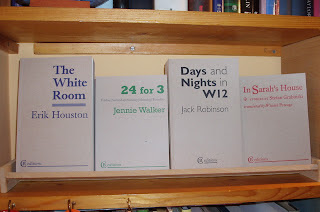
For starters, a reissue of J.O. Morgan’s first book, Natural Mechanical, first published by CBe in 2009: winner of the Aldeburgh First Collection Prize, Forward-shortlisted, all that kind of stuff and more. His more recent fiction and poetry have been published by Cape. The reissue is in A-format size, part of the little gang that started coming together last year: photo above. Available from the website now. For the first orders (I’ll stop when I start to get worried) I’ll add in copies of Morgan’s At Maldon and a Poetry Archive CD of his reading that (from memory: an hour) for free.
Among the other new titles: a memoir of growing up in London in the 1950s and later told in the contrasting voices of two sisters, with objects and playlist as well as stories and playscripts; an essay on grief and isolation that has more pages of images than text; a fantasia on Bebe Rebozo, Mafia-related buddy of Nixon in the 1970s, in the spirit of Philip Guston’s drawings of Nixon; the diary of a writer visiting a country in which (officially) there are no dogs; poems of justified rage delivered with skill and lightness.
Below, a drawing by Ron Sandford of Dai Vaughan, found last week in a back-issue of Ambit. I hadn’t seen it before. He’s at work in the cutting room: Dai was a documentary film editor. He was also a writer: ‘One of the most imperiously intelligent fiction-writers alive’ – Neal Ascherson. But not alive now. CBe published his Sister of the artist in 2012, a few months before he died, and also a pamphlet of his poems (14 short love poems written in the 1960s and another 14 written to the same woman, re-met after an absence of half a century).
Which reminds me … To fund the new titles I do need to keep selling the old ones. Season Tickets on the website: 6 books for £40, or 12 books for £75, post free. (And I’ll add in extras, such the Dai Vaughan pamphlet.)
Tuesday, 10 January 2023
Plan B
Beginning in 2007 with four books and no intention to publish more, CBe has been humming along fine for 15 years: here a prize, there a shortlisting, quite often semi-silence but every one of the books was more than worth publishing.
It’s now 2023 and print costs have been escalating and postage costs too; there are other small presses who can sell X’s new novel or Y’s book of poems into bookshops better than CBe can; and I’m into my 70s and getting smaller. From this year CBe will concentrate on publishing, perhaps exclusively, small A-format books, the model being the three books published last year in that size and with covers with image on white card (Agota Kristof, The Illiterate; Caroline Clark, Own Sweet Time; myself, 99 Interruptions). This will mean goodbye to the brown covers (those books are more expensive to print: retro costs). It will mean hello to more short books: if prose, fiction or non-fiction, say 10 to 20,000 words (rough guide only). And poetry, yes: Cape Editions did poetry in A-format, and so now do NYRB.
It feels like a good time to change tack. For the first time in 15 years, I’m entering January without any new titles (other than one delayed from last year) in preparation.
An agent or mainstream publisher will probably tell you that a book of prose of between 10 and 20,000 words is not a thing at all. But there are many different ways to skin a cat. CBe has a track record of neither-fish-nor-fowl books which don’t fit easily into the traditional bookselling categories. Is it a duck, is it a donkey? It’s writing. I’m looking forward to seeing what this bastard word count may bring to the surface.
Meanwhile, 1: the Season Tickets (6 books for £40, 12 books for £75) are still up for grabs on the website homepage. Meanwhile, 2: The Camden Town Hoard, co-published with Studio Expurgamento, is the new must-have for this year. There Will Be A Party.
It’s now 2023 and print costs have been escalating and postage costs too; there are other small presses who can sell X’s new novel or Y’s book of poems into bookshops better than CBe can; and I’m into my 70s and getting smaller. From this year CBe will concentrate on publishing, perhaps exclusively, small A-format books, the model being the three books published last year in that size and with covers with image on white card (Agota Kristof, The Illiterate; Caroline Clark, Own Sweet Time; myself, 99 Interruptions). This will mean goodbye to the brown covers (those books are more expensive to print: retro costs). It will mean hello to more short books: if prose, fiction or non-fiction, say 10 to 20,000 words (rough guide only). And poetry, yes: Cape Editions did poetry in A-format, and so now do NYRB.
It feels like a good time to change tack. For the first time in 15 years, I’m entering January without any new titles (other than one delayed from last year) in preparation.
An agent or mainstream publisher will probably tell you that a book of prose of between 10 and 20,000 words is not a thing at all. But there are many different ways to skin a cat. CBe has a track record of neither-fish-nor-fowl books which don’t fit easily into the traditional bookselling categories. Is it a duck, is it a donkey? It’s writing. I’m looking forward to seeing what this bastard word count may bring to the surface.
Meanwhile, 1: the Season Tickets (6 books for £40, 12 books for £75) are still up for grabs on the website homepage. Meanwhile, 2: The Camden Town Hoard, co-published with Studio Expurgamento, is the new must-have for this year. There Will Be A Party.
Tuesday, 6 December 2022
Artefictions
Surprise package: files of The Camden Town Hoard, published by Studio Expurgamento with CB editions, were sent to the printer today. Finished books before Christmas, if the stars align. The book can be ordered now from the website.
From the introduction by Natalia Zagórska-Thomas: ‘The Camden Town Hoard is a collection of archaeological finds dredged up from a section of Regent’s Canal, roughly between Granary Square in Kings Cross and the London Zoo. The canal was dredged by an unknown person in the spring/summer of 2021 during lockdown. The majority of the objects revealed during this time were removed from the canal towpaths by Camden Council but not before 20 or so most fascinating artefacts were rescued and accessioned into the ExPurgamento archive. Since then the collection has been studied, thoroughly documented and provided with museum labels by a team of highly trained experts from a broad variety of backgrounds and interests … Identifying and contextualising the various objects threw up several new problems related to taxonomical classification. Specifically, it has been noted that the term “artefact” may not be an entirely sufficient or appropriate description of all archaeological material and it is therefore proposed that the term “artefiction” might sometimes be used instead.’
Six books for £40, anyone? Or 12 for £75? See the Season Tickets on the website home page. For yourself or as a gift to someone else (and I’ll do the posting).
Last Sunday, at the launch of the archive catalogue of Nick Wadley – artist and art historian, 1935–2017 – at Tate Britain, we had the rare and moving privilege of being able to leaf through his sketchbooks (below). Three books of Nick Wadley’s drawings were published by Dalkey Archive. A pamphlet of 14 of his drawings (‘on bookish and related matters’) was published by CBe in 2012 – copies are available free to the next 10 people who sign up for one of the Season Tickets.
Monday, 14 November 2022
0 to around 80 in 15 years
Fifteen years ago this month I collected the first books from the printer, 10 minutes from where I live. I was happy and deeply disappointed: now that I had the bound copies in my hand I could see that the inside margins were around 3mm too narrow. The readers wouldn’t notice, most of them, but I did. An uncle had died and left me £2,000 and the previous August I’d had the notion of spending this money on publishing four books: my uncle’s money paid for 250 copies of each. There weren’t going to be any more. But then there were. Below, the first four books, and a photo taken this summer of every title published to date.
The following month, in an attempt to make the books more visible, I started this blog (this was 2007). On the very first day – 21 December – I wrote four short posts, and going back to them is strange. The first post is titled ‘Blush’, which happens to be title and subject of a collaborative book CBe eventually got around to publishing in 2019. The second post has the photo, used above, of the first four books. The fourth post has a photo of a schoolroom in Hungary in the 1930s which hung around for a while, waiting to features on the cover of Ágota Kristóf’s The Illiterate, published this year.
A snapshot history of CBe, written in instalments over the years, is downloadable (pdf) from the ‘About and News’ page of the website.
Also available from the website home page, not one but two Season Tickets. The original is still there, 12 books for £75, free delivery, but 12 books amount to a big ask so there’s now a 6-books-for-£40 option as well. If you are wondering what to give X or Y for Christmas, here is your answer. Thank you, everyone who stopped by and picked up a book.
The following month, in an attempt to make the books more visible, I started this blog (this was 2007). On the very first day – 21 December – I wrote four short posts, and going back to them is strange. The first post is titled ‘Blush’, which happens to be title and subject of a collaborative book CBe eventually got around to publishing in 2019. The second post has the photo, used above, of the first four books. The fourth post has a photo of a schoolroom in Hungary in the 1930s which hung around for a while, waiting to features on the cover of Ágota Kristóf’s The Illiterate, published this year.
A snapshot history of CBe, written in instalments over the years, is downloadable (pdf) from the ‘About and News’ page of the website.
Also available from the website home page, not one but two Season Tickets. The original is still there, 12 books for £75, free delivery, but 12 books amount to a big ask so there’s now a 6-books-for-£40 option as well. If you are wondering what to give X or Y for Christmas, here is your answer. Thank you, everyone who stopped by and picked up a book.
Monday, 12 September 2022
'Everybody has gone mad"
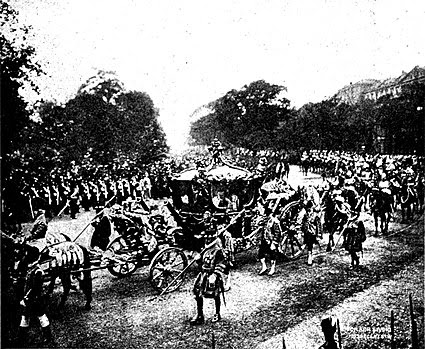
‘They crowned a king this day, and there has been great rejoicing and elaborate tomfoolery, and I am perplexed and saddened.’ That’s Jack London writing about the coronation of Edward VII in 1902 in The People of the Abyss, a book I quote from extensively in the final chapter of Good Morning, Mr Crusoe. ‘The Socialists, Democrats, and Republicans went off to the country for a breath of fresh air, quite unaffected by the fact that 40 millions of people were taking to themselves a crowned and anointed ruler. Six thousand five hundred prelates, priests, statesmen, princes, and warriors beheld the crowning and anointing … throughout the crowd were flung long lines of the Metropolitan Constabulary, while in the rear were the reserves – tall, well-fed men, with weapons to wield and muscles to wield them, in case of need.’
‘And now the Horse Guards, a glimpse of beautiful cream ponies, and a golden panoply, a hurricane of cheers, the crashing of hands – “The King! the King! God save the King!” Everybody has gone mad. The contagion is sweeping me off my feet. I, too, want to shout, “The King! God save the King!” Ragged men about me, tears in their eyes, are tossing up their hats and crying ecstatically, Bless ’em! Bless ’em!” See, there he is, in that wondrous golden coach, the great crown flashing on his head, and a woman in white beside him … And I check myself with a rush, striving to convince myself that it is all real and rational, and not some glimpse of fairyland. This I cannot succeed in doing …’
Jack London was living in the East End and writing as a journalist, with researched statistics: in this brief chapter on the 1902 coronation – an episode in the continuation of an institution that still, according to the marketing department, unites the nation – he notes that ‘five hundred hereditary peers own one-fifth of England’ and spend ‘32 per cent of the total wealth produced by all the toilers of the country’; and that in London, ‘one in four adults is destined to die on public charity, either in the workhouse, the infirmary, or the asylum’.
Read The People of the Abyss (preferably in the 2014 edition published by Tangerine Press, which reproduces the photographs included in the original 1903 edition). Of course I’d also like to sell copies of Good Morning, Mr Crusoe, which is about imperial mythology (racism and misogyny included in the package) and how historically much of Eng Lit has been co-opted by that. And, officially published this month, Caroline Clark’s Own Sweet Time and my own 99 Interruptions. And please be aware that the Season Ticket – available from the home page of the website: 12 books for £75 – is still going: started at the beginning of the first Covid lockdown in March 2020, so by now an institution, almost, less history than the monarchy but I hope more future. Actually, now would do.
Saturday, 30 July 2022
On photographs of books
Way back when, maybe 20 years ago, I wandered by chance into an exhibition of photographs by Martina Geccelli at the Goethe Institut in London: photographs not of the covers of books and not the spines but the opposite of the spines – the loose page edges, gathered but hanging free. In 2010 I got in touch with Martina and in an act of extraordinary generosity she took photos of the early CBe books and said I could use them for free. The above photograph is from a sequence of 14 (deserving fine-art reproduction, better than this blogpost). Another is on the cover of by the same author.
Martina Geccelli photographs books like Morandi painted jugs. She now runs RAUMX, a project space within her own studio in north London: ‘an open, intimate platform, outside of the commercial setting of a gallery’. Her website (not up to date but still good) has more books and examples of her other photographs (including plastic bags, pallets, and abandoned offices in the World Trade Center in NY, where she had a residency in 2000).
99% of photographs of books are photos of product, commissioned by marketing departments. They show flat fronts and elicit comments on the cover design (though frankly, until you’ve seen the spines and the backs this feels premature). Other than Geccelli, one of the very few photographers I know of who is interested in the physical form of books is the Cuban-born Abelardo Morrell. A link to some of his book photos is here, and below is ‘Dictionary', 1994:
Admittedly, Morrell favours books that are old. Books need wear and tear, or dust and neglect, to take on character. Here’s my own copy of Middlemarch, which I took on holiday and left outside on a damp night:
*
Photos of books being read are a different thing. Among the most famous are the (posed) photos by Eve Arnold of Marilyn Monroe reading Ulysses. What’s going on here? Even if the official message was She’s not just a ditzy blonde, there was no way through: men of a certain ilk like their ditzy blondes to read posh, it’s cute. Adding a link here to the list of books owned/read by Marilyn Monroe, who was far from dumb, won’t change that.
The best photos of books being read are the 65 (unposed) photos in On Reading by André Kertész. Here’s a photo of a CBe book being not read, and (posed) the aftermath:
*
A photo I took last week of 15 years of CBe (82 books, 3 pamphlets, 2 issues of a magazine, 1 CD) owes a debt – in concept, not in execution – to Martina Geccelli:
Here's the official version. And then the whole rickety edifice came tumbling down:
Subscribe to:
Posts (Atom)