Really odd piece in the TLS this week by MC about the RSL. Are you with me? Don’t worry if not, it’s an ingrown toenail in the long-running series about writers and status that no one cares about except writers. RSL = Royal Society of Literature. First two paras in the TLS are starter waffle, which is what this column does, with added pepper, and there’s a place for this and I read it.
Get to the point. Which he does in para 3: ‘According to Private Eye, the society is currently trapped in an “ideological purity spiral”’. And so it continues, lots of quotes wthin quotes, gossip, who said what to who, which is how anything bookish becomes news and gets a Guardian piece – posh people bitching.
So much of MC’s piece is in quote marks. MC himself is in quote marks: ‘We’. A couple of things I pick him up on: ‘senior RSL members’: you just mean older, don’t you? Older and whiter. You imply the new members are junior. All RSL fellows are equal, or they are not. MC’s mockery (fair enough: all selection is invidious) of the ‘specially selected’ panel that will nominate candidates for new fellowships – ‘Who selects the selectors?’ – slides comfortably past the previous old-boys club way of nominating: they selected themselves. And please, please, do not say ‘august institution’, irony is over; when Marina Warner bemoans a ‘lack of respect for older members and a loss of institutional history, which was something members cherished’, she is talking about an institution first given royal patronage by the particular King George, I forget which, there were several, who declared: ‘We do hereby declare and make known, That the Slave Population in Our said Colonies and Possessions will be undeserving of Our Protection if they shall fail to render entire Submission to the Laws, as well as dutiful Obedience to their Masters.’ That is a part of the RSL’s institutional history; I think a big part; to bemoan lack of respect for it is at the very least complacent. Why, seriously, does the RLS not ditch the Royal bit?
Thursday, 1 February 2024

Sunday, 21 January 2024
Kenneth Patchen rides again
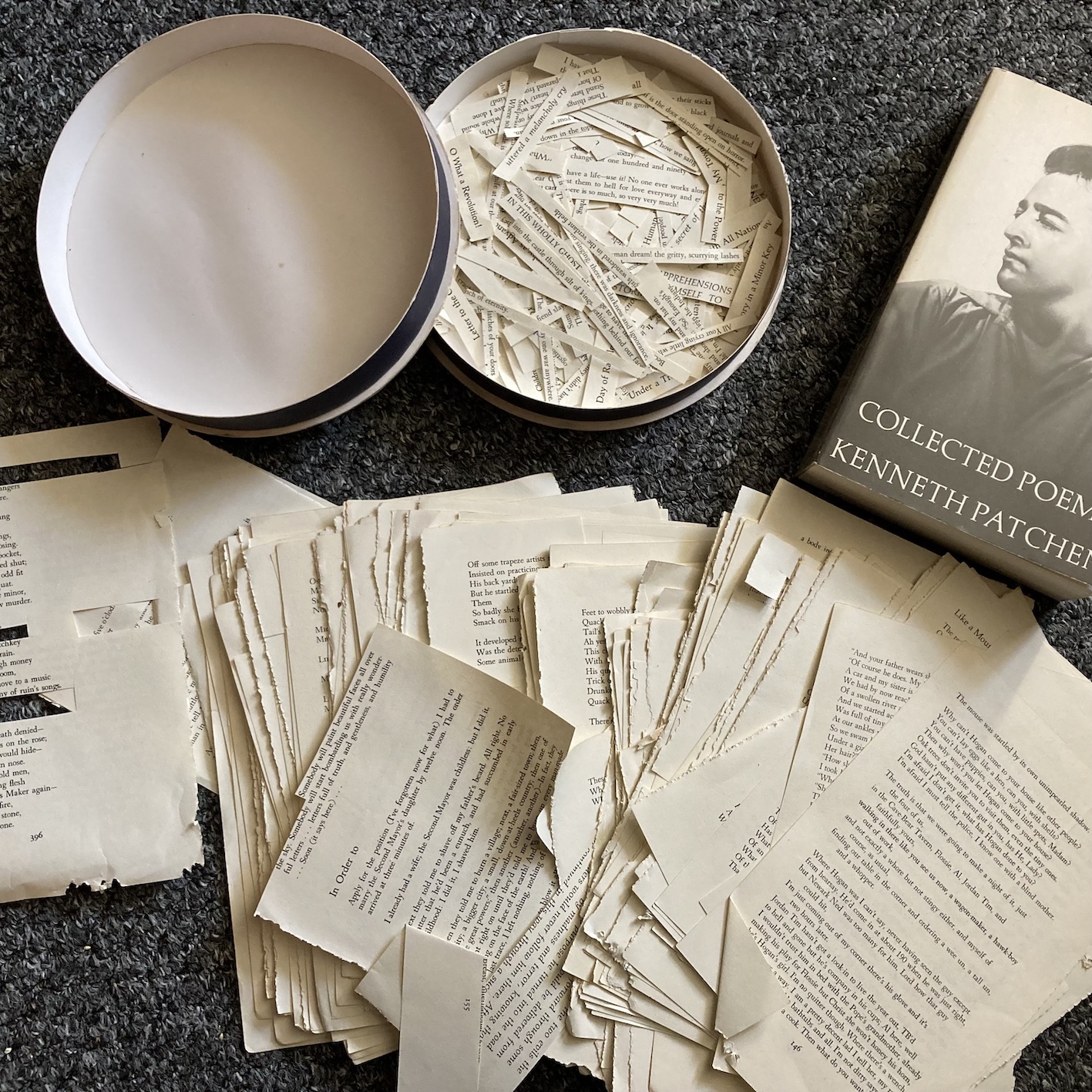
Kenneth Patchen (1911–72) is not a writer familiar to many British readers, even obsessive poetry readers, but he was important to Katy Evans-Bush in her teens – which is an age at which writers can be very important – and he was important to her again during that recent period of Covid lockdowns, lock-outs, lock-ups, cock-ups. The above photo (courtesy K E-B) shows in a nutshell, or a sweetie-box, the kindling process that led to her new collection, Joe Hill Makes His Way into the Castle. For that process spelled out, go to the page for her book on the CBe website and download the extract that gives you K E-B’s preface, and a note on Joe Hill, and a couple of the poems; and then, having got that far, buy the book. Which is officially published early in February.
Kenneth Patchen didn’t just write. Writers don’t just write. Politics were important, and music and love and coffee and bluebells, and he drew and painted. Below are some of Patchen’s book covers and his poems as artworks. (Thank you, Poetry Library at the Southbank Centre, a hugely important resource.)


Friday, 12 January 2024
Dog days

Since Christmas the view down from my desk chair has been this – Reggie, a dachshund I am dog-sitting – and I have been a member of the club of dog-keeping small presses. Kevin Duffy of Bluemoose Books posts regular photos of Lottie. William Boyd recalls visiting the ‘small cramped offices’ of Alan Ross, editor of the London Magazine and of the London Magazine editions (the model for CB editions): ‘Books everywhere, of course, but there were two dogs sprawled under his desk …’ Ross published Auden’s ‘Talking to Dogs’ in a 1971 issue of the London Magazine: ‘From us, of course, you want gristly bones/ and to be led through exciting odourscapes –/ their colours don’t matter – with the chance/ of a rabbit to chase or of meeting/ a fellow arse-hole to nuzzle at …’
2024 books: Lara Pawson’s Spent Light publishes on 23 January; she will be in conversation with Jennifer Hodgson at the London Review bookshop on 24 January. Katy Evans-Bush’s Joe Hill Makes His Way into the Castle will publish on 6 February – available from the website now (as is Spent Light).
Coming in April: the first English translation of Paris by Jean Follain (1903–71), a French poet I hugely admire and have written about. And The End of Ends by the renowned Polish theatre director Tadeusz Bradecki, written in the last year of his life: a non-fiction book about story-telling and everything else which happens to include an embedded novel.
There are birthdays galore in January and the 10th anniversary of Studio ExPurgamento (co-publisher with CBe of Blush and The Camden Town Hoard) to continue celebrating: party at the Horse Hospital on 23 January, free entry but reserve a ticket on Eventbrite. A not-bad birthday prsent for yourself or anyone else is a Season Ticket (6 books for £45, 12 for £80, post-free) from the website home page.
From the US-based organisation Pleasure Pie you can download 10 free zines about Palestine. Begin with Gazan Youth Manifesto: ‘Fuck Hamas. Fuck Israel. Fuck Fatah. Fuck UN. Fuck UNWRA. Fuck USA! We, the youth in Gaza, are so fed up with Israel, Hamas, the occupation, the violations of human rights and the indifference of the international community […] We want to be free. We want to be able to live a normal life. We want peace. Is that too much to ask?’
Monday, 4 December 2023
Lives. Books.
In the late 1970s I sat in Fulham town hall listening to Bruce Kent (CND) ask Richard Harries (who wrote on the ‘just war’ and later became Bishop of Oxford): Do the personal moral values and standards we ask of our friends also apply to politicians, or do they get a realpolitik get-out clause?
Palestine. Israel. I cannot speak on behalf of all the writers I publish, I am not their elected representative, but by definition a publisher operates in public so, for the record: damn the State of Israel’s apartheid and barbarous actions, and damn Hamas, whose own actions are those of a death cult. And damn, too, political leaders in my country and elsewhere who are prepared to accept indefinite killing and mutilation of women and children in the interests of what, precisely?
Books. A free copy of Leila Berg’s Flickerbook, which is one of CBe’s touchstone books, will be sent with the next 12 online orders. Berg: immigrant Jewish family, Manchester, defiantly left-wing and an activist for the welfare of children all her life.
Tony Lurcock’s Uncommon Places, a commonplace book by the author/compiler of a trilogy of books about Finland published by CBe that stretched to four volumes, was recommended in the TLS last week; it’s not a CBe book but is available from the website.
Books alone do not save lives. But they are voices too and my work is to get some of them heard. Either for yourself or as a present for others, see the Season Tickets on the website home page: 6 books of your own choice for £45, or 12 for £80.

Palestine. Israel. I cannot speak on behalf of all the writers I publish, I am not their elected representative, but by definition a publisher operates in public so, for the record: damn the State of Israel’s apartheid and barbarous actions, and damn Hamas, whose own actions are those of a death cult. And damn, too, political leaders in my country and elsewhere who are prepared to accept indefinite killing and mutilation of women and children in the interests of what, precisely?
Books. A free copy of Leila Berg’s Flickerbook, which is one of CBe’s touchstone books, will be sent with the next 12 online orders. Berg: immigrant Jewish family, Manchester, defiantly left-wing and an activist for the welfare of children all her life.
Tony Lurcock’s Uncommon Places, a commonplace book by the author/compiler of a trilogy of books about Finland published by CBe that stretched to four volumes, was recommended in the TLS last week; it’s not a CBe book but is available from the website.
Books alone do not save lives. But they are voices too and my work is to get some of them heard. Either for yourself or as a present for others, see the Season Tickets on the website home page: 6 books of your own choice for £45, or 12 for £80.

Thursday, 23 November 2023
More on public schools
(Earlier post here.)
Anyone who thinks that paying for a child to go to a public school will buy them a ‘good’ education needs to read the diary extracts supplied to the Covid Inquiry by Sir Patrick Vallance, the government’s Chief Scientific Adviser (2018–23): Eton-educated Johnson was confused by graphs and data and watching him try to ‘get his head round stats is awful’. Johnson struggled to understand basic scientific concepts ‘and we did need to repeat them – often’.
And then read this: ‘Man claims £1m damages over Loretto boarding school “abuse”’: ‘For me, we're talking about thousands of assaults over more than 2,000 days.’ These are allegations of torture. In the 1990s. The current headmaster of the school has stated in an email that ‘the defence of the legal proceedings is being handled by our insurers and their lawyers’.
I was at that school in the 1960s. The normalisation of violence, bullying and abuse was already in place – see the 200-page report on the school published earlier this year by the Scottish Child Abuse Inquiry. The SCAI is an ongoing inquiry into the care of children in Scottish boarding schools and other institutions. To date, the inquiry has announced 112 investigations and has completed 11 case studies. No such inquiry exists in England: it would be too expensive, it would never end.
The result of the case mentioned above will be important. Potentially, thousands of historic abuse claims for damages against public schools may follow. At the very least, the cost of the insurance policies taken out by the schools to protect themselves against such cases will rise steeply.
Anyone who thinks that paying for a child to go to a public school will buy them a ‘good’ education needs to read the diary extracts supplied to the Covid Inquiry by Sir Patrick Vallance, the government’s Chief Scientific Adviser (2018–23): Eton-educated Johnson was confused by graphs and data and watching him try to ‘get his head round stats is awful’. Johnson struggled to understand basic scientific concepts ‘and we did need to repeat them – often’.
And then read this: ‘Man claims £1m damages over Loretto boarding school “abuse”’: ‘For me, we're talking about thousands of assaults over more than 2,000 days.’ These are allegations of torture. In the 1990s. The current headmaster of the school has stated in an email that ‘the defence of the legal proceedings is being handled by our insurers and their lawyers’.
I was at that school in the 1960s. The normalisation of violence, bullying and abuse was already in place – see the 200-page report on the school published earlier this year by the Scottish Child Abuse Inquiry. The SCAI is an ongoing inquiry into the care of children in Scottish boarding schools and other institutions. To date, the inquiry has announced 112 investigations and has completed 11 case studies. No such inquiry exists in England: it would be too expensive, it would never end.
The result of the case mentioned above will be important. Potentially, thousands of historic abuse claims for damages against public schools may follow. At the very least, the cost of the insurance policies taken out by the schools to protect themselves against such cases will rise steeply.
Monday, 30 October 2023
Bananas

‘Every square meter is filled with so much stuff. Fruit vendors, lottery booths, blind singers, tires, scrap metal, old motorbikes, buckets filled small nuts, bananas gone a little bad, live and dead chickens, heaps of indistinguishable merchandise …’ This is from Gianni Celati’s description of a street market in Bamako in Mali, which I was reading during (rare) quiet periods behind the CBe table at the Small Publishers Fair in the Conway Hall last Friday and Saturday. ‘Everywhere people are selling things and chatting with an admirable indolence. Everything moves in discontinuous fluxes, trailing-off busyness, frequent encounters, continual deviations off the path. Movements that are busy, yet meandering, in the space that is packed with human bodies and lively colors, and merchandise heaped into piles. Nothing gives the impression of being isolated … In this continual rubbing up against people who speak as soon as they see you, without barriers that protect against approaches, I am forgetting the funereal privacy with which I live in England …’
Celati talks with his friend, a film-maker, ‘about the fact that in Europe the passion of business seems like a means to an end, and the end is only profit … Here, instead, it seems that living and doing business are the same thing, the same stuff as the hours of the day, for which the goal of profit is not separated from the chatting and the cloud of dust, and rarely are the encounters reduced to an anonymous rendering of services …’
Still, Celati does wonder ‘What is the profit of the cigarette vendor in front of the hotel who sells perhaps ten packs a day? And the profit of the woman selling ten bananas total, on a little table in the street?’ For the record: CBe sold 87 books over the two days of the fair, for an average of £8.50 per book (which is less than the cover price of any one book, which varies between £8.99 and £14, because I was offering two for £16). A few more than ten bananas. And I gave away a few, and 30 free copies of Farthings. There were discontinuous fluxes and frequent encounters and deviations off the path. Enormous thanks to Helen Mitchell for enabling the fair to happen.

And now a new banana, perfectly ripe, freshly delivered: Lara Pawson’s Spent Light, which publishes in January 2024 but is available now for pre-orders from the website.
Plenty other bananas. They keep well. Selling not from a little table but from the website, where bulk orders, also known as Season Tickets – 6 titles of your own choice for £40, 12 for £75 – are available from the home page. Think of the website as a street market.
Sunday, 15 October 2023
A tale of two book fairs

1. Above: flyers for the first two years of Free Verse: The Poetry Book Fair.
In 2011 the Arts Council cut funding to a number of poetry presses. It might be fun, I thought, to do something, to show what was under threat. I emailed some people. I hired a hall in Exmouth Market – £250 – and some trestle tables. I put together a pamphlet with poems and an essay by Michael Horovitz. Katy in the pub said: No readings? Where was I living, in the 1950s? There happened to be a room above the hall to hire. Chrissy Williams came in and arranged the readings.
24 September 2011: 22 publishers, a tight fit. There was a tube strike that day but people came. A woman with a lovely voice who was busking on the street came in and did a set on the stage. People bought books. It happened, and I think what took everyone by surprise was the surge of good will. Random quotes from feedback over the next days: ‘It was like a holiday … People came in droves. Really. Not only did they come, they spent money; lots of money … A book fair can be a revelation and, on Saturday, Free Verse was … With poets, publishers and, most importantly, readers brought face to face, you were reminded of what's actually important and of how much time and energy gets wasted drawing up binary or even balkanised models of the poetry world … The Free Verse fair was inaugurated in a spirit of defiance, collaboration and small-scale entrepreneurship … I am very much hoping this will become an annual event. Judging by the number of people who poured through the doors while I was there (and the number of people leaving with bags as heavy as mine was!) it should be.’
The following year the fair hosted 50 publishers over two floors at Candid Arts. Chrissy was up and running, determined that we should make no distinction between the big publishers (with their tiny poetry lists) and the little ones, who operate far and wide. (Cape said no; they couldn’t work out whether the £40 table charge should be costed to the marketing or the publicity budget. Faber, bless them, told us how difficult it would be to get someone to sell books on a Saturday.) We got ACE funding to pay travel costs to presses from far afield and to pay the people running workshops. In 2013 the fair moved to the Conway Hall and Joey Connolly joined the gang; I dropped out the following year. 2014–17: around 80 presses participating each year; welcome assistance from enthusiastic volunteers; readings (both inside and out of doors), workshops, evening events in nearby pubs.
In 2018 Chrissy and Joey stepped back and management of the book fair was taken over by the Poetry Society. Chrissy in 2018 (quoted on the book fair’s website): ‘We know the Poetry Society will be able to give [the Poetry Book Fair] a more stable and secure future. We’re delighted that they've agreed to take it on, and look forward to seeing how it flourishes in their hands.’
The last Poetry Book Fair was in 2020. The Poetry Society – which receives more than £350,000 per year from ACE, but the book fair is not one its core activities – has no current plans to get it going again. This tends to be what happens when a very small outfit is taken over by a larger one: it disappears.

2. Above is the flyer for this year’s Small Publishers Fair, to be held at the Conway Hall on 27 and 28 October.
The Small Publishers Fair is basically run by two people: Helen Mitchell, who has organised the annual fair since 2012, and the designer and publisher Colin Sackett, who has been involved since the beginning in 2002. Advisers and close supporters are acknowledged on the website. ‘There’s a balance of geography (around 2/3 of publishers come from outside London or around the world) and of diversity of work (artists books, poetry, fine press, zines, etc).’ During Covid, instead of cancelling they ran an online ‘slow book fair’ over two months. The fair is focused, efficient, friendly, relaxed. It generates good will. They have found a recipe and it works and they don’t faff with it. If you want something done well, this – ‘independent, self-funding and not-for-profit’, and run by just two or three people – may be the only way to do it. CBe is honoured to be invited to take part.
Of course, you don’t have to wait until the end of the month to buy books. See, for example, the Season Tickets (6 books of your own choice for £40, or 12 for £75) on the CBe home page.
Subscribe to:
Posts (Atom)