Friday, 31 December 2021
Old year, new year
In 2021 CBe published eight books and paid its bills and made 215 trips to the post office. The financial adviser may differ but it was an excellent publishing year.
Also in 2021 I abandoned the pen-name Jack Robinson. The cover it originally served as (explained in The Other Jack) has long since been blown. But I’m still interested in the whole matter of Robinson (Good Morning, Mr Crusoe) and I’ve been reading and enjoying Peter Robinson’s learned, clever, funny, angry The Constitutionals – in which the narrator (nicknamed Crusoe in childhood) perambulates around the town of Reading, ‘hoping to trigger the end of neoliberalism by going for a walk’.
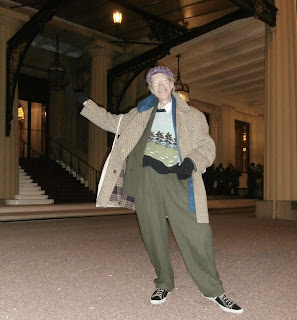
Among writers who died in 2021 was Michael Horovitz. He lived nearby and I was very fond of him. The photo above shows Michael arriving at Buckingham Palace for the poets’ jamboree a few years ago. Great jumper, but the pose is surely ironic: if he is proclaiming ‘To the barricades, citizens!’, he is also amused and even happy to be here, welcomed in to the heart of the establishment. He was invited, and he accepted. (As did I. I drove him there. There were checks under the car for bombs and checks under the car bonnet – which then refused to close, so we drove in through a very high archway with the bonnet clanging.) The contradiction here is often apparent in the national annual pantomime, the New Year’s ‘Honours List’.
As usual, getting the books into bookshops has been head-against-brick-wall. Roy Watkins’ Simple Annals was called ‘a masterpiece’ in the Literary Review and ‘an astonishing achievement’ in the TLS; on Leila Berg’s Flickerbook in the TLS, ‘Reading it is a joy; brutally honest depictions of childhood liberate the child within … This reissue is wholly welcome.’ Sales into bookshops: around 50 copies of each.
I liked the Republic of Consciousness tweet that said Carmel Doohan’s Seesaw was unlike even those other books that are unlike anything you’ve ever read. They meant it in a good way. And I liked the very recent review of Nuzhat Bukhari’s Brilliant Corners that had an informed argument and recognised the book’s context.
Small indie presses (and CBe is as small as they get) are often independent to the point of, when you dig down, loopiness. Titles that have sold in serious (to me) numbers – David Markson’s This Is not a Novel, Agota Kristof’s The Notebook, Will Eaves’ Murmur, May-Lan Tan’s Things to Make and Break, Christopher Reid’s The Song of Lunch – are now not on the list because my license to publish ran out or someone with a faster car came along. That’s hardly a way to run a business. But publishing both is and isn’t a business, and it’s the isn’t bit that I enjoy more.
Looking back: click here to read a snapshot/bite-size history of CBe, 2007–2021. (If the link doesn’t work, you can download it as a pdf from the ‘About and News’ page of the website.) Despite the titles that have wandered off there are still around 70 in print and for the Season Ticket arrangement you can have 10 of these (you choose which) and usually a couple more for £70, post free. I am very, very grateful to everyone who has pressed that button – some of them three times, some four. CBe receives no Arts Council funding.
Looking forward: four or five new books in 2022. I can mention Paul Bailey’s Joie de vivre, which officially publishes in February, because finished copies are in, but I can’t spell out the others because I’m not that organised. Or I am organised but in a different way. Happy New Year.
Sunday, 5 December 2021
Shopkeeping
This country is a nation of shopkeepers, as Napoleon may or may not have said, and he didn’t mean it as a compliment. Publishers whose rejections say ‘We think this is a wonderful book but sorry, no, we don’t think we can sell it’, politicians who decide what policies to adopt on the basis of how many people they think will vote for them … This is infantilising, and the attendant media embed this process.
But I happen to have a shop and it’s shopping season and I do want to sell more books. Not cupcakes. While thinking that four books a year might be about right for a one-person operation, CBe has published eight this year. I have failed better. In chronological order of publication: Roy Watkins, Simple Annals (‘an absorbing masterpiece’, Bernard O’Donoghue, The Literary Review; ‘an astonishing achievement’, Brian Morton, TLS); Dan O’Brien, A Story that Happens (‘a book for our times’, Alice Jolly, TLS); Nuzhat Bukhari, Brilliant Corners (‘Real-world violence juxtaposed against the page, the proximity of the singular self to the wider brutality of history’, Andrew McMillan, PBS Bulletin); Leila Berg, Flickerbook (‘Reading it is a joy; brutally honest depictions of childhood liberate the child within’, Norma Clarke, TLS); Charles Boyle, The Other Jack (‘Whatever a novel is, I feel this is what I want a novel now to be’, Jane Feaver); Tony Lurcock, Finish Off with Finland, the fourth book in his trilogy (‘entertaining, fascinating, astonishing’, Finland Forum); Carmel Doohan, Seesaw (‘an unexpected, novel challenge to binary thinking’, Laura Waddell, Scotsman); Caroline Clark, Sovetica (‘I was moved, in several directions: inwards, outwards, backwards in time and into my present’, Patrick McGuinness).
All orders from the website are welcome. Especially welcome are buyers who sign up to the Season Ticket, which works like a Book Token: 10 books of your choice for £70, post-free in the UK, for yourself or for Uncle Arthur. You’d pay the same for designer socks.
Below, the pop-up shop in Portobello Road run by CBe a few years ago:
Sunday, 21 November 2021
CBe Season Ticket
When I was eight years old I wanted to be a bus driver. Since 2007 I’ve been driving a bus called CB editions and although when you get on you can never be completely sure where the bus is going – it doesn’t always stick to the same route, sometimes it goes a little off-piste – the views out the window are lovely.
You can buy tickets from the website. You can also buy a Season Ticket. This is the new name for the Lockdown Subscription, which was first offered at the start of the first lockdown in March 2020 – since when, a number of readers have come back for repeat subscriptions. New name but everything else stays the same: ‘For £70, you’ll receive one CBe book per week in the post for a period of 10 weeks. (£7 per book, free delivery, and sometimes I’ll throw in two books rather than one.) UK addresses only.’ All the books on the website are available, plus Will Eaves’s Murmur and Agota Kristof’s The Notebook. To tell me which books you want – or which you don’t want – just email info@cbeditions.com.
It works like a Book Token: you choose your own books. People have been known to buy subscriptions – sorry: Season Tickets – as presents for friends and family. Just saying.
Wednesday, 17 November 2021
Not cricket
Above, title page of a book sent to me last week by a CBe author who knows I like cricket. Bought in a charity shop, which feels right. First published 1936, ‘revised and reprinted’ 1946. There was a world war between those dates but you’d hardly notice, reading the book. 'The Author': buttoned-up.
It’s not cricket: ‘said to mean that someone's behaviour is unfair or unreasonable’ (Collins English Dictionary). ‘If behaviour is not cricket, it is not fair, honest or moral’ (Cambridge Dictionary). Yorkshire cricket’s defence against the testimony of Azeem Rafiq, Yorkshire cricketer, about racism in Yorkshire cricket was – for as long as they could hold the line, for as long as they and not Rafiq held the power to decide what is ‘fair’ or ‘reasonable’ – that it wasn’t cricket.
I’m invested. I’m Leeds-born and I’ve watched not just Jonny Bairstow but his dad, David Bairstow (who played for Yorkshire and England and killed himself). I’ve even written a novel about cricket. And in football I follow Leeds, who signed one of the first black players to play top-flight English football, Albert Johanneson, I watched him too, who got monkey chants every game and who died alone in a Leeds council flat, his body not discovered until a week later, a quarter of a century ago, yesterday, today.
Yorkshire cricket is institutionally racist, clearly. (No sport has more obvious links to empire than cricket.) As is this country, as are dictionaries and Eng Lit and a whole lot of publishing and me, I grew up within these institutions. Stop arguing the toss; stop putting quote marks round that phrase. I’ve been trying to make this not about me, but I am implicated. Is Rafiq going to win Sports Personality of the Year in December (for lit readers, it’s kind of the sport Booker Prize)? I want that.
Monday, 1 November 2021
'Reading it is a joy'
Authors chase reviews, me too – validation, credibility. Someone else likes the book, besides your mum and your publisher. Your dad? Good question. Reviews rarely increase sales unless they are cumulative, one review and then another and another, momentum gathering, the book beginning to trend. And the delivery of most reviews, despite the reviewer having paid attention and written carefully, is perfunctory and formulaic, especially the group reviews. But indulgently, going for it, I’m pasting here the complete (‘In Brief’) TLS review by Norma Clarke of Leila Berg's Flickerbook, which happens to be a foundation CBe title (see previous blog post), because it’s as good as it gets.
'Leila Berg was in her late seventies, a noted children’s author, champion of comprehensive schools and progressive education, and crusader for children’s rights – and especially the right of all children to read for pleasure (and find images of themselves in books) – when she decided to relive her own childhood and youth. She was emphatic: Flickerbook was a reliving, not an act of remembering, and it was traumatic to write. It was the last book she wrote, though she lived another fifteen years, dying in 2012 at the age of ninety-four.
'Reading it is a joy; brutally honest depictions of childhood feelings liberate the child within. No retrospective adult reasoning softens the account. Her parents are monsters. “He hates me”, she writes of her father. He gives her black looks and doesn’t speak to her. She hates him. (He had wanted a boy.) As soon and as often as she can, she absents herself from home. Growing up in a working-class Jewish district of Salford, she has the cultural riches of Manchester on hand: concert halls, theatres, free public libraries, music shops where she can listen to music without quite finding anything she wants to buy with her carefully saved bus fare.
'Clever, impassioned, often enraged, she has to work the world out for herself. “Nobody tells you anything.” Why is Jewish bread different from Christian bread? Why did two boys at infant school bang her head against a wall and accuse her of killing Jesus? A teenager in the 1930s, she joins the Young Socialists and campaigns against fascism. She is an activist. She likes boys, likes her own body, doesn’t want to get married, doesn’t want to be owned or live her mother’s life but enjoys sex (and writes beautifully about it). Her lover joins the International Brigade and is killed in Spain. A second lover likewise. “They die so fast in Spain.” The volume ends with Chamberlain’s announcement of war with Germany and the sound of the first air-raid siren “swooping, scooping, sickening”. Soon there will be many more deaths.
'Memory flickers like a loose lightbulb; “flickerbook” is another name for flipbook – a series of pictures that when flicked through produce the impression of a moving picture. Flickerbook proceeds through glimpses and vignettes, short paragraphs and big leaps, but there is more of a narrative structure than the title might suggest. It is artful in the best sense, and a radical experiment in memoir-writing. Very quietly the important themes are developed: integrity, honesty, inclusiveness, freedom of thought. Some parts are very funny, and it is through a shared sense of humour – they laugh at Marx brothers films – that young Leila forms a guarded late friendship with her widowed father. This reissue is wholly welcome.'
It’s easy to print books, hard to get to them to readers. Flickerbook is available from the website here. And the 10-books-for-£70 Subscription offer is still operating, from the website home page.
'Leila Berg was in her late seventies, a noted children’s author, champion of comprehensive schools and progressive education, and crusader for children’s rights – and especially the right of all children to read for pleasure (and find images of themselves in books) – when she decided to relive her own childhood and youth. She was emphatic: Flickerbook was a reliving, not an act of remembering, and it was traumatic to write. It was the last book she wrote, though she lived another fifteen years, dying in 2012 at the age of ninety-four.
'Reading it is a joy; brutally honest depictions of childhood feelings liberate the child within. No retrospective adult reasoning softens the account. Her parents are monsters. “He hates me”, she writes of her father. He gives her black looks and doesn’t speak to her. She hates him. (He had wanted a boy.) As soon and as often as she can, she absents herself from home. Growing up in a working-class Jewish district of Salford, she has the cultural riches of Manchester on hand: concert halls, theatres, free public libraries, music shops where she can listen to music without quite finding anything she wants to buy with her carefully saved bus fare.
'Clever, impassioned, often enraged, she has to work the world out for herself. “Nobody tells you anything.” Why is Jewish bread different from Christian bread? Why did two boys at infant school bang her head against a wall and accuse her of killing Jesus? A teenager in the 1930s, she joins the Young Socialists and campaigns against fascism. She is an activist. She likes boys, likes her own body, doesn’t want to get married, doesn’t want to be owned or live her mother’s life but enjoys sex (and writes beautifully about it). Her lover joins the International Brigade and is killed in Spain. A second lover likewise. “They die so fast in Spain.” The volume ends with Chamberlain’s announcement of war with Germany and the sound of the first air-raid siren “swooping, scooping, sickening”. Soon there will be many more deaths.
'Memory flickers like a loose lightbulb; “flickerbook” is another name for flipbook – a series of pictures that when flicked through produce the impression of a moving picture. Flickerbook proceeds through glimpses and vignettes, short paragraphs and big leaps, but there is more of a narrative structure than the title might suggest. It is artful in the best sense, and a radical experiment in memoir-writing. Very quietly the important themes are developed: integrity, honesty, inclusiveness, freedom of thought. Some parts are very funny, and it is through a shared sense of humour – they laugh at Marx brothers films – that young Leila forms a guarded late friendship with her widowed father. This reissue is wholly welcome.'
It’s easy to print books, hard to get to them to readers. Flickerbook is available from the website here. And the 10-books-for-£70 Subscription offer is still operating, from the website home page.
Friday, 8 October 2021
To writers submitting their work
First, and obviously: given the amount of blood, sweat, tears and toil that you’ve invested in your work, let alone the time and money, it would be perverse not to spend 5 minutes on the Net finding out who you are sending it to. Me. Not ‘Editor’, not ‘To whom it may concern’, not ‘CBe team’. There is no team. Nor are there any ‘submission guidelines’.
You’d know this if you’d read the snapshot history of CBe that’s downloadable from the ‘About and News’ page on the website, but that’s 22 pages long and writers are busy people. Let’s keep this short.
Is your work ‘a good fit for the list’? CBe has no manifesto but, looking at the list of titles I’ve published, I see they’re a bit short on plot and rhyme. I do like ‘proper’ novels, with weather and ‘character development’, but they are not why CBe is here. Just give me good sentences, any time of the day. About a recent CBe book, someone said that it’s ‘unlike even those other books that are unlike other books’; some of the books don’t have a chance of winning prizes because they slip shy of all of the prize categories.
Practicalities. If CBe publishes your work, you get an advance of around £300 against royalties of 10% on net sales and a first print run of maybe 350 copies. That may be that. Around a fifth of the books CBe has published have sold fewer than 100 copies; a few have sold more than 3,000 copies. No ebook. If someone outside the UK is worried about not just postage costs but delivery, I’ll send them a pdf.
I can’t promise you a big presence in bookshops, or reviews. The set-up is reasonably professional – CBe has a distributor and a sales agent – but I don’t have a little black book.
CBe has been publishing since 2007 without Arts Council support (I made three applications in the early days, and then stopped). If CBe’s position on the margins of the publishing industry may be considered arrogant (in its aloofness from the commercial fray) or political, or both, I’ll take that, but this is largely because of an accidental combination of low resources, age (I’m 70) and personal temperament. As I said, there’s no manifesto.
You’d know this if you’d read the snapshot history of CBe that’s downloadable from the ‘About and News’ page on the website, but that’s 22 pages long and writers are busy people. Let’s keep this short.
Is your work ‘a good fit for the list’? CBe has no manifesto but, looking at the list of titles I’ve published, I see they’re a bit short on plot and rhyme. I do like ‘proper’ novels, with weather and ‘character development’, but they are not why CBe is here. Just give me good sentences, any time of the day. About a recent CBe book, someone said that it’s ‘unlike even those other books that are unlike other books’; some of the books don’t have a chance of winning prizes because they slip shy of all of the prize categories.
Practicalities. If CBe publishes your work, you get an advance of around £300 against royalties of 10% on net sales and a first print run of maybe 350 copies. That may be that. Around a fifth of the books CBe has published have sold fewer than 100 copies; a few have sold more than 3,000 copies. No ebook. If someone outside the UK is worried about not just postage costs but delivery, I’ll send them a pdf.
I can’t promise you a big presence in bookshops, or reviews. The set-up is reasonably professional – CBe has a distributor and a sales agent – but I don’t have a little black book.
CBe has been publishing since 2007 without Arts Council support (I made three applications in the early days, and then stopped). If CBe’s position on the margins of the publishing industry may be considered arrogant (in its aloofness from the commercial fray) or political, or both, I’ll take that, but this is largely because of an accidental combination of low resources, age (I’m 70) and personal temperament. As I said, there’s no manifesto.
Sunday, 3 October 2021
'What was it like?'
4 October is publication date of Sovetica by Caroline Clark, a book that includes photographs taken in Moscow in the 1980s by Clark’s husband Andrei and a friend accompanied by short texts (poems?) by Clark based on Andrei’s memories of those years. Clark herself lived in Moscow for ten years. To listen to three short audio excerpts from the conversations (in Russian) from which the texts derived, click here. Below, with her own photos of Moscow, Caroline Clark tells how the book came about.
To start with there was the scale of the city with its intimidating perspectives and unbarricadable boulevards. I looked up at the past, across the distances. I was out of context.
The past had never felt so closed off. There were no roads in. One place of refuge for me, Neptune swimming pool, had issues of its own looming over it.
But as I lived there, it became my home. And I came to love a different story that I read in the gentle curves of tram rails rounding a slow corner.
The stool the hairdresser put outside on warm days for her breaks, the old dustbins shaky but still there, benches moored to their fixtures, barricades, walls, steps, railings, urns. Almost all, I’m sure, gone now.
These things had a homeliness about them resulting, perhaps, from the human intention of the design coupled with later abandon. But there was something else: they were telling me something, answering the question I was asked back home so much: ‘What was it like?’
Then A showed me his 3-D slides and all at once I could look into that past. And I could ask, ‘What was it like?’
I love the mechanism of question/answer. You don’t know something. You ask what was it like. You are told. A hole is filled. Or: a door is opened. You discover more to ask. What was it like, what was it like?
I was fascinated by the slides. And fascinated by Andrei's ability to speak about himself and tell a good story. Memories. So embodied they are like objects stored, never varying, ready to be told again. A good story rises up whole. It is told and placed on the shelf. It is unabashed. Simply itself. It comes easily, when needed.
So easy. It shouldn’t be this easy. Oh, it was. Easy and fun and always right. I knew when the texts were right. They felt just so. Just-so stories. They felt light. And set. And as little of me as possible. How novel. Whose are they? Certainly not mine. These words have travelled and belong in a book called Sovetica. I hope you will enjoy it.
To start with there was the scale of the city with its intimidating perspectives and unbarricadable boulevards. I looked up at the past, across the distances. I was out of context.
The past had never felt so closed off. There were no roads in. One place of refuge for me, Neptune swimming pool, had issues of its own looming over it.
But as I lived there, it became my home. And I came to love a different story that I read in the gentle curves of tram rails rounding a slow corner.
The stool the hairdresser put outside on warm days for her breaks, the old dustbins shaky but still there, benches moored to their fixtures, barricades, walls, steps, railings, urns. Almost all, I’m sure, gone now.
These things had a homeliness about them resulting, perhaps, from the human intention of the design coupled with later abandon. But there was something else: they were telling me something, answering the question I was asked back home so much: ‘What was it like?’
Then A showed me his 3-D slides and all at once I could look into that past. And I could ask, ‘What was it like?’
I love the mechanism of question/answer. You don’t know something. You ask what was it like. You are told. A hole is filled. Or: a door is opened. You discover more to ask. What was it like, what was it like?
I was fascinated by the slides. And fascinated by Andrei's ability to speak about himself and tell a good story. Memories. So embodied they are like objects stored, never varying, ready to be told again. A good story rises up whole. It is told and placed on the shelf. It is unabashed. Simply itself. It comes easily, when needed.
So easy. It shouldn’t be this easy. Oh, it was. Easy and fun and always right. I knew when the texts were right. They felt just so. Just-so stories. They felt light. And set. And as little of me as possible. How novel. Whose are they? Certainly not mine. These words have travelled and belong in a book called Sovetica. I hope you will enjoy it.
Subscribe to:
Posts (Atom)


